A Turbo-Vision-inspired character-mode UI framework for Common Lisp (SBCL),
rebuilt around CLOS. It gives you overlapping movable windows, dialogs,
controls, a mouse-aware event system and a DOS-style colour/palette model — all
rendered with ANSI escape sequences in any modern terminal. Views draw through
named theme roles resolved to a 24-bit RGB theme and matched to the
terminal automatically (true-colour → xterm-256 → 16-colour), so colours are
exact and themeable — and a view can also paint arbitrary per-cell true
colour (make-rgb) when it wants a gradient or image.
Where a classic Turbo Vision port hand-computes TRect bounds, dispatches on 138
integer command constants and calls draw-view after every mutation, revision uses a
reactive metaclass (a changed slot write invalidates just the affected window), CLOS event classes
dispatched by multimethods, named commands resolved through layered
keymaps, and a box-model layout DSL. See revision/README.md
for the architecture in depth.

The toolkit standalone; revl — the SLIME-class IDE — is one application built on it:


- SBCL
- A POSIX terminal with
stty(macOS/Linux) - No external Lisp libraries to build, run, or test — the framework depends
only on SBCL itself. The threaded REPL/debugger tooling in the example app
use SBCL's own facilities (
sb-thread,sb-mop,sb-di, and thesb-introspectcontrib, all bundled with SBCL).
The project loads through ocicl (the current
directory is on the ASDF source registry via ~/.sbclrc), so
(asdf:load-system :revision) just works. Because there are no third-party
dependencies there is nothing to ocicl install.
The smallest standalone revision program — one window with a greeting and an OK
button (examples/hello-world.lisp, run it with sbcl --script):
(asdf:load-system "revision")
(in-package #:revision)

(defun hello-world ()
  (let ((win (ui (window (:title " revision " :keymap *global-keys*)
                   (stack
                     (:fill (static-text :text ""))
                     (1 (row (:fill (static-text :text ""))
                             (13 (static-text :role :label :text "Hello, World!"))
                             (:fill (static-text :text ""))))
                     (1 (row (:fill (static-text :text ""))
                             (8  (button :label "OK" :command 'quit))
                             (:fill (static-text :text ""))))
                     (:fill (static-text :text ""))
                     (1 (static-text :role :status :text " Press Esc, q, or OK to quit ")))))))
    (run-view win)))     ; runs full-screen until QUIT

(hello-world)
Structure is a box model: stack splits vertically, row horizontally, cells
are :fill (take the rest) or an integer height/width. Keys map to named
commands; commands are methods on the command name; views react to slot changes
automatically. See revision/README.md for the ui macro,
keymaps, commands, theming, and the reactive metaclass.
| Module | Responsibility |
|---|---|
base/ |
the foundation: geometry (points/rects), colors (attribute byte ↔ ANSI SGR, RGB themes), draw-buffer (the cell model + the Unicode/grapheme/display-width engine), events (event records + key/mouse/command codes), screen (raw mode, alternate screen, diff-based ANSI rendering, input decoding), and the outline-node tree data structure |
revision/ |
the CLOS-native toolkit: the reactive metaclass, CLOS event dispatch, keymaps → commands, the ui layout DSL, theming, MOP persistence, the worker→UI bridge, and the widget/window/dialog/menu set — the text editor, outline tree, table, scrollback transcript, HTML view, and the desktop shell with its window+menu plugin registry. (The Lisp-IDE windows — REPL, debugger, inspector, project tree, browsers — live in the revl application, not here.) |
The whole framework lives in a single revision package (one defpackage
in base/package.lisp): base/ populates it with the foundation symbols and
revision/ adds the kernel, so revision:make-attr, revision:run-desktop, and
everything else share one namespace. That :export is the single source of
truth for the public API — a grouped, deliberate contract; every exported symbol
is documented, and API.md is a generated reference (make api).
Each cell carries a full 21-bit code point, so any Unicode character can be typed
and rendered. Double-width glyphs (CJK and most emoji) claim two cells (via
sb-unicode's east-asian-width), and grapheme clusters (combining marks,
ZWJ / skin-tone emoji) are interned into a single cell, so they render as one
glyph and arrow-keys / backspace / mouse / selection treat them as one unit.
Word-wrap reflows wide glyphs whole rather than splitting them at the boundary.


The framework's flagship example, revl — a SLIME-class Lisp REPL / IDE
that exercises the whole framework (overlapping windows, menus, dialogs, the
syntax-highlighting editor, the object inspector, an HTML browser, a threaded
sldb-style debugger, and code-intelligence tools: completion, paredit, source
navigation, tracing/profiling, a HyperSpec lookup) — lives in its own repository:
Clone it next to this checkout and build:
git clone git@github.com:lispnik/revl.git   # alongside this revision checkout
cd revl && make && ./revl
It reaches this framework through a systems/revision symlink to the sibling
checkout, so the two build together with no global configuration. Its
framework-agnostic Lisp logic lives in a shared revl-logic system, so the IDE
reuses it directly on revision. See that project's README for the full feature tour.
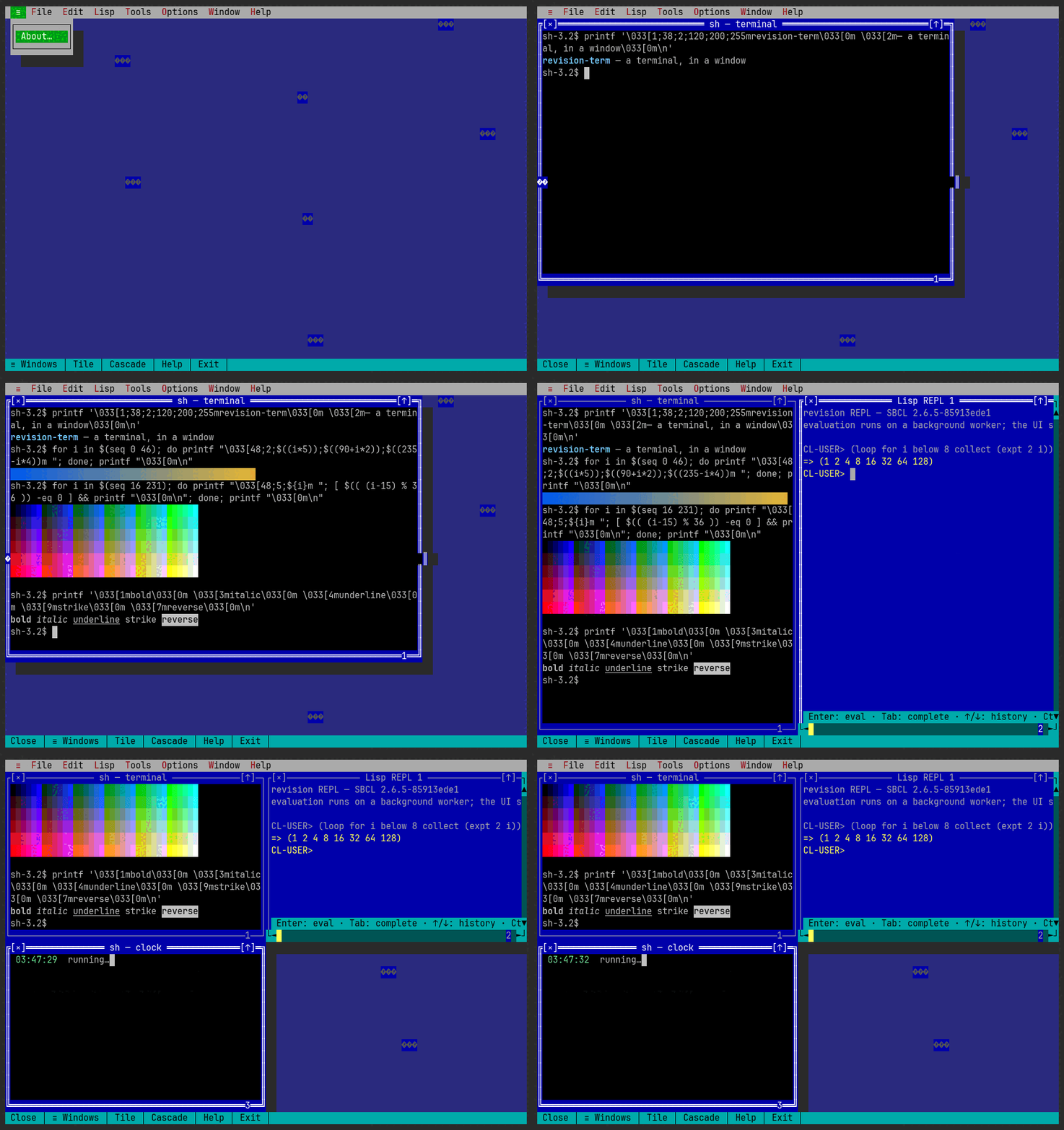
revision-term is a reusable terminal window for the framework: it runs
a real child process (your shell, vi, top, …) on a pseudo-terminal, emulates
it with libvterm (via CFFI), and renders the emulated screen into a
revision view — so a live terminal becomes a first-class window that any
revision app can embed, alongside the REPL, editor, and the rest. It shows off
the framework's 24-bit colour and text-style attributes with full fidelity
(true-colour, bold/italic/underline, wide CJK/emoji, combining marks).
make            # build check: compile + load the framework
make test       # headless suites (editor display-width + widgets, and the desktop shell)
make api        # regenerate API.md — the public-API reference — from the docstrings
make keybindings # regenerate KEYBINDINGS.md from the keymaps
The headless suites cover the editor's display-width (wide CJK / emoji) + widget
layout, the desktop shell + window/menu plugin registry (opening/closing windows
through *window-builders*, *extra-menus* merging), and a keybinding-reference
drift check; they exit non-zero on any failure (CI-ready) and need nothing but SBCL.
The example app's own tests — the REPL backend, the debugger, the inspector, and an
end-to-end pty smoke test — live with it in github.com/lispnik/revl.
MIT.