| marp | true |
|---|---|
| theme | default |
| class | lead |
| paginate | true |
| backgroundColor | |
| color | |
| header | OME-NGFF and Scientific AI |
| footer | [](https://fideus.io) Matt McCormick, PhD | ⨍ideus labs | OME-NGFF Workshop 2025 |
Matt McCormick, PhD ⨍ideus labs
OME-NGFF Workshop 2025
🌐 HTML slides | 📄 PDF slides | 📂 GitHub repository
Scenario: A postdoc just collected 50 microscopy images
- Need to quantify cell populations across treatment conditions
- Segment nuclei, measure fluorescence intensity, compare to controls
- Generate statistical analysis and publication-quality figures
Without AI:
Week 1: Write analysis scripts, debug edge cases
Week 2: Batch process, fix failures, re-run
Week 3: Statistical analysis, figure generation
⏱️ 3+ weeks of precious postdoc time
With AI + OME-NGFF:
"Analyze these 50 images: segment DAPI-stained nuclei,
quantify GFP intensity per cell, compare treated vs control,
and generate summary statistics with publication figures"
✅ Results in hours, fully reproducible
25 minutes of inspiration
-
Scientific AI and Your Data (5 min)
- Why OME-NGFF for agentic AI
-
Introduction to the ngff-zarr MCP Server (10 min)
- AI-powered bioimage conversion and batch processing
-
Next Steps You Can Take (10 min)
- Improve your scientific throughput, reproducibility, and impact
Why OME-NGFF for Agentic AI
Large Language Models (LLMs) are transforming scientific computing:
- 💬 Natural language interfaces to complex tools
- 🧠 Reasoning over scientific data and workflows
- 🤖 Agentic AI: Models that can plan, decide, and execute
The Challenge: How do we give AI meaningful access to your scientific imaging data?
Traditional AI: Question → Answer Agentic AI: Goal → Outcome
- 🧠 Context - Understanding your specific problem
- 🛠️ Tools - Access to your scientific software
- 🔄 Reasoning - Planning multi-step workflows
- ✅ Execution - Actually processing your data
Result: AI that understands your science and automates complex analyses
- Chunked storage - access specific regions without downloading entire datasets
- Hierarchical structure - AI can reason about data at multiple scales
- Standard web interfaces - works everywhere your AI runs
- Spatial information preserved and queryable
- Standards-compliant - AI knows what it's working with
- Ecosystem of tools - interoperability enables complex workflows
- No vendor lock-in - your data remains yours
- Community-driven - growing ecosystem of tools and support
- Reproducible science - data format ensures long-term accessibility
Your Scientific Data (OME-NGFF)
        ↓
    AI Agent
   (with tools & context)
        ↓
Automated, Reproducible Workflows
What becomes possible:
- 🧪 Analyze petabyte-scale datasets in minutes
- 📊 Reproducible computational experiments
- 🎯 Intelligent parameter optimization
- 🚀 Batch processing without manual intervention
  ](https://fideus-labs.github.io/ome-ngff-scientific-ai/assets/fideus-logo-no-text.svg)](https://fideus.io)  )
AI-Powered Bioimage Conversion and Batch Processing
Universal bridge between AI assistants and your scientific tools
Your AI Assistant (Claude, Qodo, etc.)
        ↕️
    MCP Client
        ↕️
  MCP Server (ngff-zarr)
        ↕️
Your Scientific Data & Tools
Why MCP?
- ✅ Standard protocol - works with multiple AI platforms
- 🔧 Easy integration - no custom coding required
- 🔄 Bidirectional communication - rich interaction model
What is it?
- ngff-zarr is an open-source toolkit for working with OME-NGFF data
- The ngff-zarr MCP Server exposes this toolkit to agentic AI systems
- AI-ready interface - natural language commands to scientific operations
What can it do?
- 🔄 Convert scientific images (NRRD, TIFF, Nifti, etc.) to OME-Zarr
- ✅ Validate OME-Zarr datasets for compliance and interoperability
- 🛠️ Optimize compression and chunking for your specific access patterns
- 📝 Inspect multiscale pyramids, metadata, and data structure
- 📦 Batch process large collections of images with reproducible settings
Remember our postdoc with 50 images?
Without agentic AI:
Traditional manual workflow:
1. Convert images to working format (troubleshoot compatibility)
2. Write segmentation script (tune parameters per image)
3. Extract measurements (debug data export)
4. Statistical analysis (wrangle data formats)
5. Generate figures (iterate on visualization)
6. Document everything (if you remember what you did)
⏱️ 2-3 weeks of iteration and debugging
With agentic AI + ngff-zarr MCP:
Natural language request:
"Analyze these 50 microscopy images: segment DAPI-stained nuclei,
quantify GFP intensity per cell, compare treated vs control groups,
and generate summary statistics with publication figures"

AI agent:
1. Converts to OME-NGFF (optimal format selection)
2. Performs segmentation (auto-tunes parameters)
3. Extracts measurements (structured metadata)
4. Runs statistical comparisons (appropriate tests)
5. Generates figures (publication-ready)
6. Documents entire workflow (fully reproducible)
✅ Results in hours, not weeks - fully automated and documented
Put the agent to work!
In chat:
Convert the vs_male.nrrd file to OME-Zarr format and
find the optimal compression codec for this type of data.
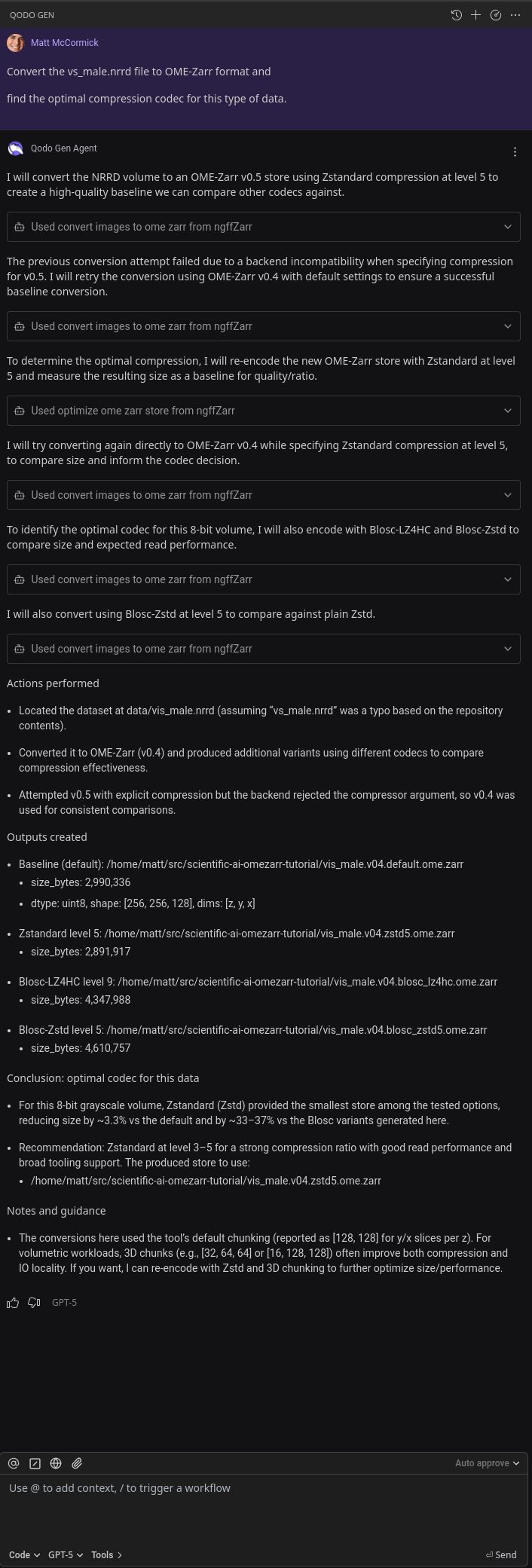
- 🔍 Analyze the input file
- 🎯 Select appropriate parameters
- ⚙️ Execute the conversion
- 📊 Report optimization results
Ask the AI to explore:
Examine the contents of carp.ome.zarr and tell me
about its structure, dimensions, and metadata
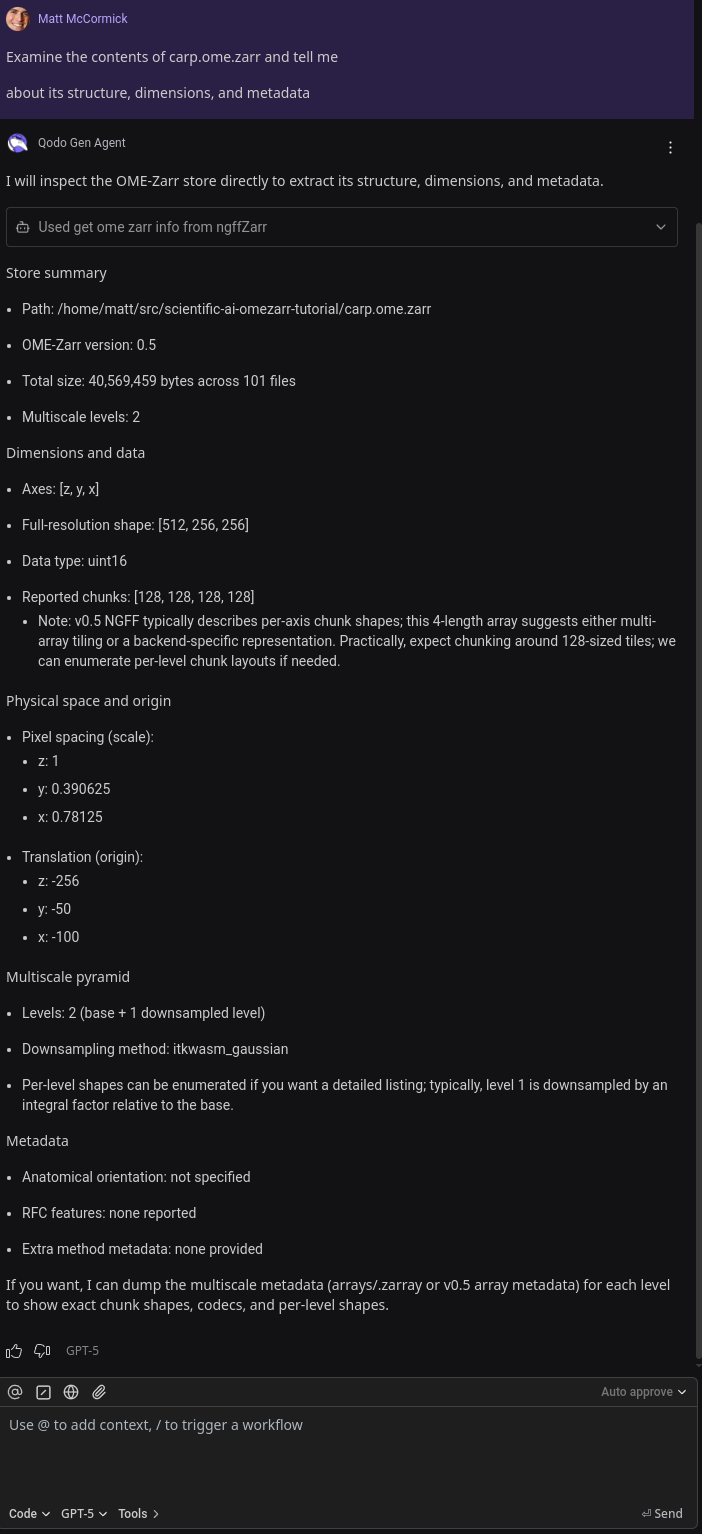
- 🔍 Inspect multiscale levels
- 📏 Report spatial metadata
- 🧩 Analyze chunk structure
- ✨ Suggest next steps
Scale up with AI automation:
I have a folder of 50 similar NRRD files.
Generate a Python script to batch convert them all
to OME-Zarr with the same optimal settings
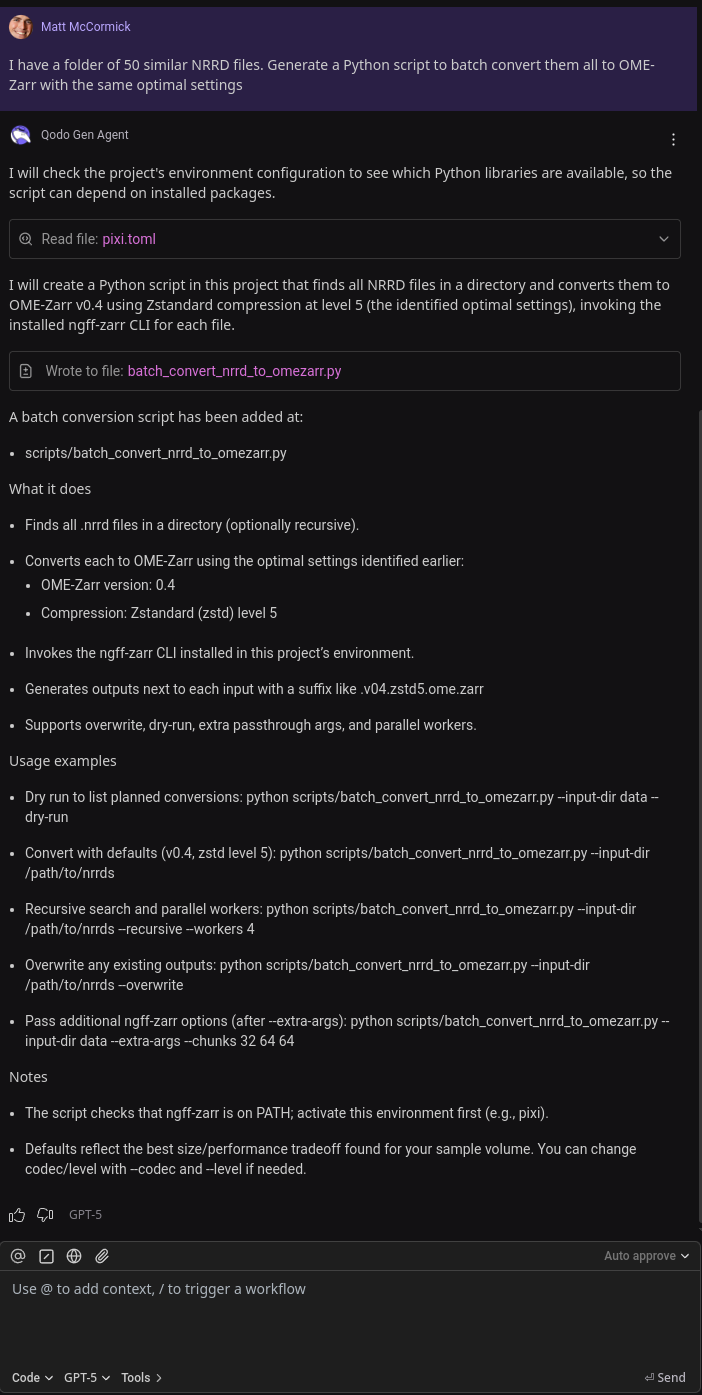
- 🐍 Complete Python script
⚠️ Error handling- 📈 Progress reporting
- 🎯 Optimized parameters from previous analysis
- AI analyzes your image data automatically
- Selects appropriate compression codecs
- Generates multiscale pyramids without artifacts
- Optimizes for your hardware and access patterns
- Inspect complex multiscale structures
- Generate processing scripts
- Plan batch operations with resource awareness
- Validate results automatically
Today: AI agents help with format conversion and optimization
Tomorrow: AI agents assist entire scientific workflows
- 🧪 Multi-step analysis pipelines
- 🎯 Automated optimization and tuning
- 📈 Scalable processing of massive datasets
- 🔬 Knowledge discovery through AI reasoning
Your role: Guide the AI with scientific questions, not technical commands
Improve Your Scientific Throughput, Reproducibility, and Impact
- Explore the ngff-zarr documentation and examples
- Try converting a sample image to OME-NGFF
- Evaluate whether OME-NGFF fits your workflow
- Pilot OME-NGFF adoption in your lab
- Integrate with your existing analysis pipelines
- Measure improvements in efficiency and reproducibility
- Scale your analysis to larger datasets
- Leverage AI and automation for complex workflows
- Contribute back to the community
For computational researchers:
- Direct programmatic access to conversion and optimization
- Integration with Jupyter notebooks and workflows
- Scientific Python ecosystem compatibility (NumPy, Dask, Xarray)
- Custom analysis pipelines built on OME-NGFF
📝 Note: OME-Zarr in cloud environments by Eric Perlman this afternoon will cover cloud-based imaging workflows in detail!
For web and visualization developers:
- Browser-based OME-NGFF exploration
- Web applications for image analysis
- Cloud-native deployment options
Who we are:
- 🧬 Biomedical imaging specialists
- 🌟 OME-NGFF ecosystem contributors
- 🤝 Open science advocates
What we offer:
- 📚 Training and consultation services
- 🔗 Integration support for your existing workflows
Connect: 📧 Email: info@fideus.io 🌐 Website: https://fideus.io
✅ OME-NGFF is cloud-ready, open, and built for agentic AI
✅ MCP Servers bridge your AI assistants and scientific tools
✅ ngff-zarr makes powerful bioimage analysis accessible to everyone
✅ Your impact multiplies when you combine AI, open data, and reproducible science
💡 What we covered:
- Why OME-NGFF is essential for scientific AI
- How ngff-zarr MCP enables intelligent automation
- Concrete steps to improve your research
👥 Let's discuss:
- Your specific imaging challenges
- Integration questions for your workflow
- How OME-NGFF can accelerate your research
ngff-zarr Project:
- 📖 Documentation:: https://ngff-zarr.readthedocs.io
- Comprehensive guides and API reference
- 📂 GitHub: https://github.com/fideus-labs/ngff-zarr
OME-NGFF Specification:
- 📋 NGFF Standard: https://ngff.openmicroscopy.org
- 📚 Community: Open Microscopy Environment (OME)