


Find regular expressions vulnerable to catastrophic backtracking (ReDoS) — fast, static, and dependency-free.
A single innocent-looking regex like (\w+)+$ can take exponential time on a
crafted input — long enough to freeze a request handler and take a service down.
redos finds those patterns without importing or running your code: it parses
your source with the standard-library ast module, then inspects the parsed
structure of every literal regex for the constructs that cause catastrophic
backtracking.
It has zero runtime dependencies, runs in CI (non-zero exit on findings), and is tuned for a low false-positive rate — patterns that Python's own regex engine rewrites into a safe, linear form are deliberately left alone.
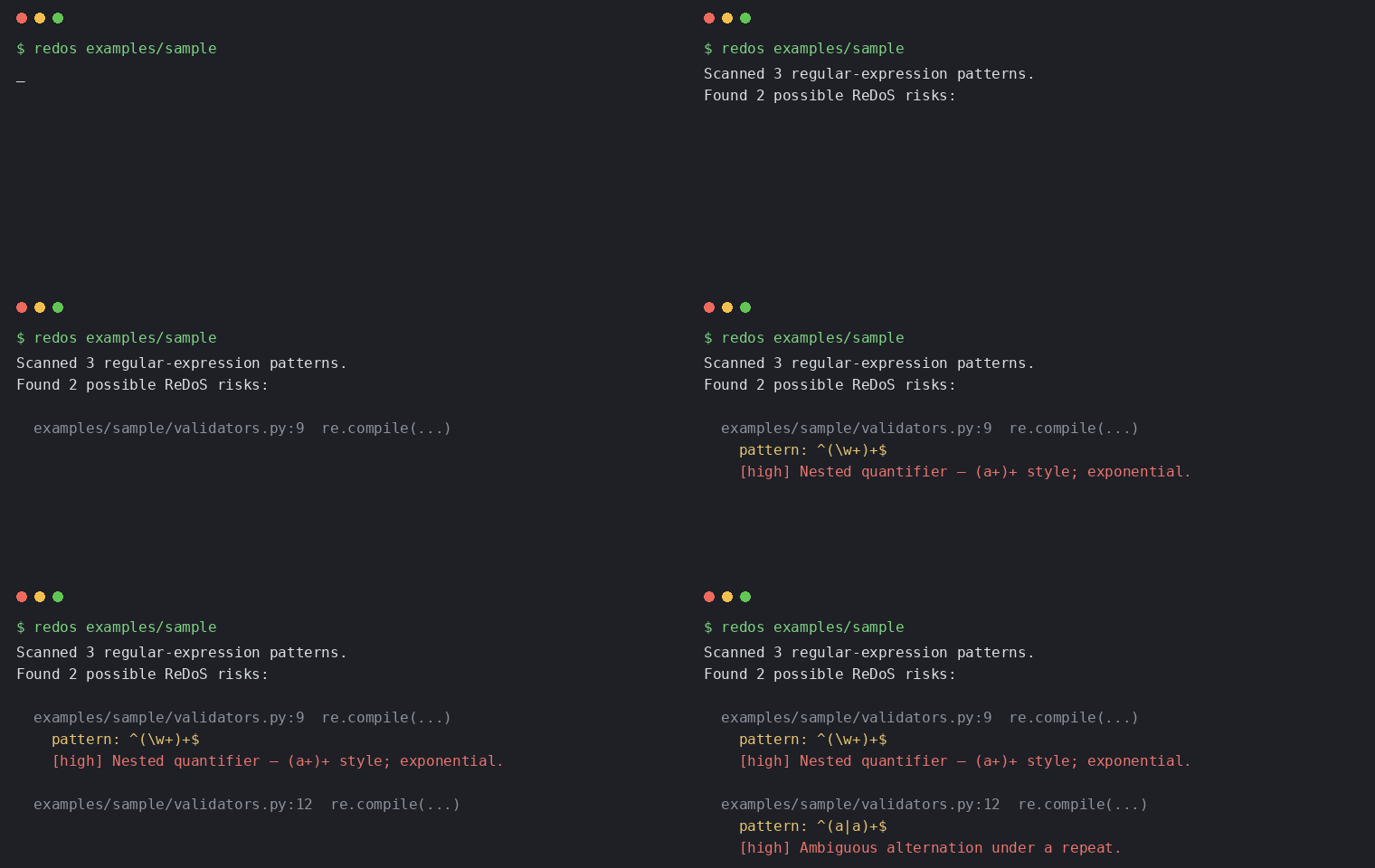
The
examples/sampleproject contains two vulnerable regexes so you can try it immediately:redos examples/sample.
pip install redosOr run from a checkout without installing:
PYTHONPATH=src python -m redos path/to/project# Scan the current directory
redos .
# Scan a specific file or package
redos path/to/your_package
# Machine-readable output for tooling
redos . --format json
# Skip directories (repeatable); common ones are skipped by default
redos . --exclude examples --no-fail$ redos examples/sample
Scanned 3 regular-expression patterns. Found 2 possible ReDoS risks:
examples/sample/validators.py:9 re.compile(...)
pattern: ^(\w+)+$
[high] Nested quantifier: a repeated group that itself repeats (such as (a+)+) can backtrack exponentially.
examples/sample/validators.py:12 re.compile(...)
pattern: ^(a|a)+$
[high] Ambiguous alternation under a repeat: two branches can match the same text, which can backtrack exponentially.
| Code | Meaning |
|---|---|
0 |
No risky patterns found |
1 |
One or more risky patterns found |
2 |
Error (e.g. path not found) |
Pass --no-fail to always exit 0 (useful when you only want the report).
redos reports two well-understood causes of catastrophic backtracking:
- Nested quantifiers — a repeated group that itself repeats, such as
(a+)+,(a*)*,([a-z]+)+, or(\w+)*. - Ambiguous alternation under a repeat — alternatives that can match the
same text inside a repeat, such as
(a|a)+, or a.branch like(.|a)*.
It analyses the regex after Python's parser applies its optimisations, so
patterns the engine makes safe — e.g. common-prefix factoring in (abc|abd)+,
or (\w|\d)+ collapsing to a single character class — are not flagged.
Only literal patterns passed to re (or regex) functions are analysed.
Patterns built from variables or expressions are skipped on purpose, so the tool
never guesses and never invents findings.
- Scan each
.pyfile withastand collect every literal pattern passed to a known regex function (re.compile,re.match,re.search, …). - Parse each pattern with the standard-library regular-expression parser to get its real structure (the same structure the engine executes).
- Inspect that structure for nested unbounded quantifiers and ambiguous alternation under a repeat, reporting each with its file, line, and reason.
Add this to your project's .pre-commit-config.yaml and redos runs on every commit:
repos:
  - repo: https://github.com/gazzycodes/redos
    rev: v0.1.0
    hooks:
      - id: redos
Then pre-commit install once, or run it on demand with
pre-commit run redos --all-files.
- uses: actions/setup-python@v5
  with:
    python-version: "3.x"
- run: pip install redos
- run: redos .
The non-zero exit on findings fails the job automatically.
git clone https://github.com/gazzycodes/redos
cd redos
PYTHONPATH=src python -m unittest discover -s tests -v
Contributions are welcome — please open an issue or PR.
MIT — see LICENSE.
